Paper Trails, Fabricated Pasts: Inside the Quiet Market for Counterfeit Credentials
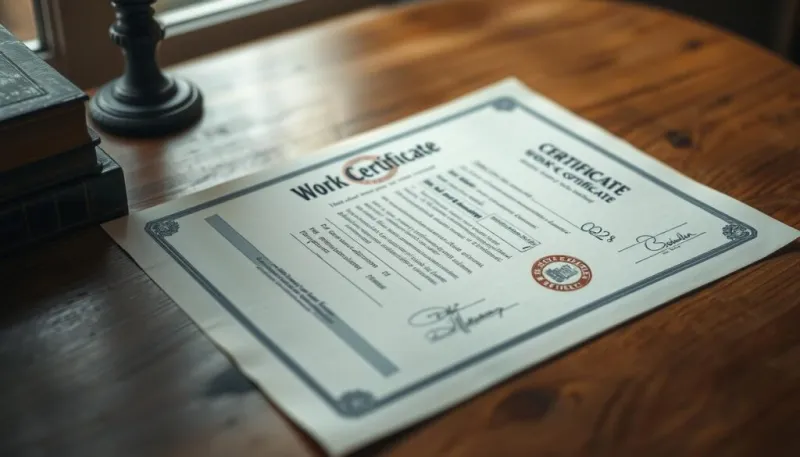
Photo: forged diploma certificate documents on desk investigation, via www.wirtschaftspuls-bayern.de
The transaction takes less than ten minutes. A mid-level professional in Ohio selects a diploma from a well-known state university, uploads a headshot, pays $400 through a digital wallet, and receives a sealed transcript, a verification-ready registrar contact, and a LinkedIn-ready credential within the week. No crime scene. No forced entry. Just a document that will pass almost every background check an American employer can throw at it.
Credential fraud is not a fringe phenomenon. It is a functioning market with suppliers, customer reviews, and seasonal discounts around graduation season. And the enterprises most exposed to it are the ones still treating hiring verification as a paperwork exercise rather than a security discipline.
The Industry Behind the Illusion
Diploma mills have evolved. Today's operations do not simply print certificates; they manufacture entire verification ecosystems. Fake registrar phone lines are staffed. Counterfeit transcripts use correct paper weights, seals, and fonts. Some vendors maintain working web portals that mimic legitimate university lookups, designed specifically to satisfy a background-check vendor's due diligence.
The demand side is equally rational. American workers face escalating credential requirements for roles that have not meaningfully changed in a decade. When a position demands a degree that the labor market no longer reasonably prices in, a $400 forgery starts to look like arbitrage. The FBI has repeatedly warned about fraudulent degrees used to obtain positions in healthcare, engineering, and government contracting — sectors where a fabricated qualification is not merely embarrassing but genuinely dangerous.
Why Traditional Screening Fails Quietly
The standard background check is a process of calling sources that can themselves be faked. Verification typically means contacting an institution, comparing a name and date, and moving on. It confirms that a record exists — not that the record is authentic, not that the person presenting it earned it, and not that the document hasn't been altered between issuance and presentation.
Three structural weaknesses recur:
- Source trust is assumed, not proven. A background-check vendor cannot cryptographically distinguish a genuine registrar from a well-built imitation.
- Documents are static. A PDF or paper transcript carries no living link to its issuer and cannot be re-validated after the fact.
- Verification is one-time. A credential checked in 2019 is never checked again, even as the person's role, access, and risk profile change.
The result is a hiring pipeline that looks rigorous, produces dense compliance folders, and still admits fabricated credentials at scale.
What Tamper-Proof Records Change
Cryptographically anchored credentials invert the model. Instead of an employer trusting a document, the issuer — a university, a licensing board, a certification body — writes a tamper-evident record to a shared, immutable ledger. The graduate holds a verifiable credential that anyone authorized can confirm in seconds, without calling anyone.
The practical consequences are significant. Forgery becomes computationally pointless rather than merely difficult, because a fake credential carries no valid cryptographic signature. Revocation becomes instant: a license suspended for misconduct disappears from the verified state immediately, not at the next background-check cycle. And verification stops depending on the vigilance of whichever HR coordinator happens to be reviewing the file.
Several US states have already moved in this direction — MIT has issued blockchain-anchored diplomas since 2017, and state education departments have piloted verifiable digital records for high school transcripts. The infrastructure exists. Adoption is the bottleneck.
The Cost of Not Knowing
Enterprises tend to frame credential fraud as an HR nuisance. The exposure is broader. A falsified engineering license can void professional liability coverage. A fabricated clinical certification can trigger regulatory action that reaches far beyond the individual. Post-breach, discovery that a trusted employee never held the claimed qualification converts an internal problem into a public governance failure — one that boards, insurers, and plaintiffs' attorneys will all examine.
There is also a quieter cost: the erosion of internal trust. Once one fabricated credential surfaces, every unverified record in the organization becomes suspect, and the remediation effort dwarfs what source-level verification would have cost initially.
Verification at the Source, Not the End
The uncomfortable conclusion is that most hiring fraud is not detected — it is simply never checked thoroughly enough to be found. Enterprises that verify credentials only at the point of hire are inspecting the last link of a chain they did not forge and cannot control.
Cryptographic credential records move the point of trust back to where the credential was actually created. Until that becomes standard, the $400 diploma will keep clearing the $40,000 background check — and the enterprises paying for both will keep calling the result diligence.